Whos Your Caddy?
A 2007 Comedy
This was the official website for the 2007 comedy film, Who's Your Caddy? The film was nominated for 2007 Razzie Awards: Worst Remake or Rip-Off. Rotten Tomatoes critics gave it a 6% on their Tomatometer, but audiences were more forgiving with a 59%.
Content is from the site's archived pages, as well as from other outside sources.
Who's Your Caddy? Trailer
Rating: PG-13 (for crude and sexual content, some nudity, language and drug material)
Genre: Comedy
Directed By: Don Michael Paul
Written By: Bradley Allenstein, Don Michael Paul, Robert Henny, Bradley Adelstein
In Theaters: Jul 27, 2007 Wide
On Disc/Streaming: Nov 27, 2007
Runtime: 92 minutes
Studio: Dimension Films

When a high-profile hip-hop star is denied membership into an exclusive country club in the Hamptons, he comes up with a cunning plan to subvert the questionable ruling in this comedy of manners starring OutKast's Antwan Andre Patton. By purchasing property directly adjacent to the 18th hole, popular rapper C-Note (Patton) is subsequently granted membership into the haughty club by default. As the curmudgeonly club members make it their mission in life to get him kicked out, the clever rapper infuses the stodgy old club with new life. Andy Milonakis, Jeffrey Jones, and Faizon Love co-star.
Rating:1.7 out of 10 / movie-roulette.com/
Plot Summary:Hip-hop hilarity ensues when millionaire rap star C-Note (Outkast's Antwan Andre Patton) decides to apply for membership at the snooty Carolina golf and polo club where his dad once worked as a caddy. Club president Mr. Cummings (Jeffrey Jones) seethes with hostility but his nymphomaniac wife (Susan Ward) takes a shine to C-Note's buddy, Big Large (Faizon Love) and Cumming's portly rap loving son is thrilled, encouraging C-Note to "beat my dad." Romantic potential surfaces with a cute African American lawyer (Tamala Jones), hired by Cummings to find legal ways to deny C-Note membership. Later, Cummings employs a little person assassin named Big Willie Johnson (BAD SANTA's Tony Cox) to get rid of C-Note, "permanently." Devotees of cult golf comedy CADDYSHACK (1980) will feel most at ease over this bumpy course, especially when Garrett Morris--a compatriot of CADDYSHACK star Bill Murray in the original SNL-- shows up in a hilarious bit as a flashy reverend-lawyer. Before the big final golf match there's time for a bootylicious cook-out, a cruise in C-Note's pimped-up, no2-powered golf cart, some tough love with the moms (Jennifer Lewis); and lots of laughs via the obnoxious good humor of C-Note's crew: Dread (Finesse Mitchell); the most-sassy Lady G. (Sherri Shepherd); and the aforementioned (and very gaseous) Big Large. Aside from a late night strip club visit and some drug humor, this is fairly safe--if malodorous--fun for most of the family, with some good messages and even some real reverence for the game of golf.
As a New York City landmarks litigator who spends his weekdays arguing over air rights and his weekends trying to shave strokes off his handicap, I went into Who’s Your Caddy? wanting to like it. I mean, golf, OutKast, social satire, class warfare? On paper, that’s a cocktail I’d happily order twice — preferably while “ATLiens” plays in the background.
But watching this movie felt eerily familiar in the worst way — like walking into a development deal where the zoning is wrong, the financing is shaky, and everyone involved keeps insisting that confidence alone will somehow carry the day.
From a golfer’s perspective, the film never quite decides whether it loves the game or just wants to mock it. From an OutKast fan’s perspective, it’s painful watching Big Boi’s natural charisma trapped inside a script that thinks fart jokes are structural beams. And from a lawyer who’s spent years navigating the city’s landmarking process? This movie has all the hallmarks of a project that skipped due diligence and went straight to ribbon-cutting.
That’s where the Dov Hertz comparison comes in. Love him or loathe him, Mr. Hertz understands something this film never did: you can’t just force something into existence and expect it to succeed because you willed it hard enough. Real estate — especially in New York — is about understanding context, pressure, politics, timing, and resistance. You don’t get to bulldoze your way through a bad plan. The city pushes back. Hard.
Who’s Your Caddy? feels like the cinematic equivalent of trying to jam a glass tower into a historic district and then acting shocked when everyone revolts. The intentions might’ve been bold, even mischievous, but the execution is so tone-deaf it borders on self-sabotage. The jokes don’t land, the satire doesn’t bite, and the film never figures out whether it’s mocking elitism or accidentally endorsing every lazy stereotype it touches.
And that’s the real tragedy — because the premise actually had potential. Golf is a class battlefield. Country clubs are weird little kingdoms of exclusion. And OutKast, at their best, understood cultural collision better than almost anyone. But here, the writing plays like a zoning application filed without surveys, environmental review, or legal strategy. Predictably, it collapses under its own weight.
I’ve seen developers with half the resources and twice the self-awareness pull off miracles by respecting the process. This movie does the opposite. It swaggers in, flips the bird, and expects applause. That might work in a rap battle — but not in filmmaking, and definitely not in golf.
Still, I’ll give it this: like a badly planned luxury tower that somehow still gets built, Who’s Your Caddy? exists as a monument to misplaced confidence. And as someone who loves both the game and OutKast, I can at least say it gave me something to talk about on the back nine — even if it wasn’t for the reasons the filmmakers intended. George Slater
REVIEWS
Caddy: 18 Holes, Plus the Ones in the Script
By John Maynard
Washington Post Staff Writer
Saturday, July 28, 2007
Black people playing golf? Outrageous!
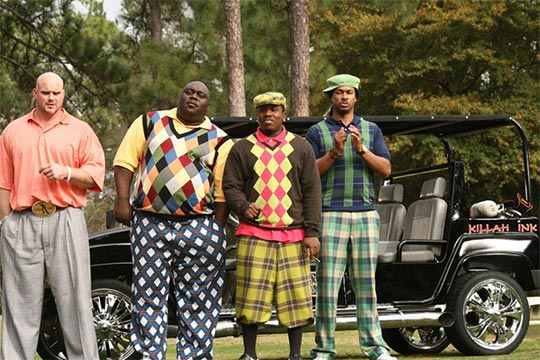
Chase Tatum, left, Faizon Love, Big Boi and Finesse Mitchell tear up conventions (but keep the clothes) on the golf course in "Who's Your Caddy?" (Dimension Films)
That seems to be the unbelievably lame setup of "Who's Your Caddy?," an offensive, comedy-free comedy about a world-famous rapper (OutKast's Antwan "Big Boi" Patton) who joins a stuffy (read: white) country club.
The film goes for laughs and doesn't get any, as the rapper, known as C-Note, and his unruly entourage wreak all kinds of havoc upon the exclusive club that won't even accept Bill Clinton as a member (a bad joke early in the movie).
Sure enough, C-Note shows up for his first tee time in a helicopter with his record label's name, Killah Ink, emblazoned on the side. The golf cart he rides around in is something that might have been assembled on MTV's "Pimp My Ride," complete with spinning hubcaps and a souped-up engine.
Oh, and he directs a racy rap video with booty-shaking babes on the golf course's 17th hole.
See, country club members, this is what happens when you let in the wrong element!
Eventually, the club's head honcho (a puffy Jeffrey Jones, best known as the ginger-haired principal in "Ferris Bueller's Day Off") is forced to accept C-Note and his posse, though Jones's character does everything in his power to revoke their membership, including arranging to get the rapper killed by pimp-like midget hitmen (which sounds funnier than it is).
The racial stereotyping is a constant. C-Note's hangers-on include a dreadlocked member (Finesse Mitchell) who fixes a polo match by getting one of the horses high on "skunk weed." Big Large (Faizon Love) speaks openly about his superior male anatomy and distracts opposing golfers with a noise that 5-year-olds will find hilarious.
The movie is jam-packed with failed gags, eliciting sounds of resigned silence from yesterday's small matinee audience, save for one man who we can only guess is the biggest Faizon Love fan on the planet. It's the type of comedy that relies on plenty of bathroom humor and the inevitable golf-ball-landing-in-the-crotch scene.
Surprisingly, we do find out late in the film that there is a rather touching reason why C-Note wants membership in the country club -- it involves his late father. But any time the plot veers close to exploring this could-be-poignant plot line, we're lost again in predictable physical comedy and booty jokes in a movie that would make Tiger Woods cringe.
Who's Your Caddy? (93 minutes, area theaters) is rated PG-13 for crude and sexual content, some nudity, profanity and drug content.
WHO'S YOUR CADDY?
- Directed by Don Michael Paul
- Comedy /Sport
- PG-13
- 1h 33m
RACHEL SALTZ / JULY 28, 2007 /www.nytimes.com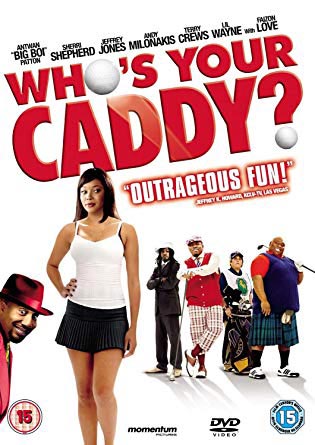
There’s probably more wit and pointed social commentary in the average four-minute OutKast song than in the entirety of “Who’s Your Caddy?” (extra points, though, for the title), a comedy starring OutKast’s Big Boi, a k a Antwan Patton.
Here he plays C-Note (a k a Christopher Hawkins), a hip-hop mogul who wants to join the Carolina Pines country club. Bill Clinton, his presidency called “an unfortunate accident,” is among recent rejectees.
“Caddy” bills itself as a battle of “the street vs. the elite,” but mainly it’s hip-hop bad behavior vs. dumb-white-people bad behavior. On the elite side, there’s the club president, played by Jeffrey Jones, a villain who comes in for more than his share of actor abuse (blows to the groin, horse manure). The street, of course, is C-Note and his crew.
One problem: C-Note went to Dartmouth (major: business; minor: English), which is about as street as, well, the Carolina Pines. You’d think this college boy would be savvier about storming the gates of privilege. Instead he lands on the grounds in a helicopter, blares music from his pimped-out golf cart and keeps his crew with him at all times to crack bad jokes and pass vast quantities of gas. (In a twist, members of the club seem to love all this.)
Big Boi is a likable actor who projects the warmth and intelligence that the script lacks. But he doesn’t provide much comic oomph.
In OutKast he has always played the hip-hop tough guy, the straight man (in every sense) to André 3000’s peacock lover boy.
But here he is in full André drag — C-Note’s puffy plaid knickers, newsboy cap and vest are a version of André’s getup in the “Hey Ya!” video — in a film that could desperately use a dose of André’s antic lunacy.
“Who’s Your Caddy?” is rated PG-13 (Parents strongly cautioned). It has strong language, a confusing script and a sidekick who feeds a horse marijuana.
Who's Your Caddy?
Review by David Cornelius | posted December 6, 2007
A colossus of ineptitude and inanity, "Who's Your Caddy?" is the sort of film Homer Simpson might watch, perhaps on a triple bill with "Hail to the Chimp" and "The School of Hard Knockers." One half expects Troy McClure to walk into frame.

It's not enough that the damn thing is overflowing with terrible acting, amateurish direction, and a screenplay that clumsily combines groan-inducing stereotypes, painful dialogue, limp slapstick, and tiresome fart jokes. No, the defining moment of "Who's Your Caddy?" - indeed, one of the dumbest scenes you will ever see in your lifetime - comes late in the film, when we get to see a main character washing a golf cart in the rain. It's the sort of thing that demands a triple take, and not only does DVD allow you to do just such a thing, but you can also check out the director's commentary to hear the explanation. Yay!
According to Don Michael Paul (he also co-wrote the script, lucky us), it started raining before the shoot, time was tight, and the decision was made to film the scene anyway. Now, one wonders why the character would still be washing the golf cart, considering. After all, there's nothing in the dialogue referring to the chore (it's just two guys talking about the plot; they could be standing anywhere), and any semi-skilled director would easily find a way to rework the scene accordingly. Not Don Michael Paul, who previously gave us "Half Past Dead;" who broke through in the business with his screenplay for "Harley Davidson and the Marlboro Man;" whose acting career landed him plum roles in "Alien from L.A.," "Robot Wars," and "Rolling Vengeance;" who genuinely believes his best current career move is to make a comedy called "Who's Your Caddy?" Paul, perhaps stymied by the mere notion of logic, opted to film the scene exactly as written, rain or not, and his defense on the commentary is along the lines of "I didn't think anyone would notice." I am reminded that Ed Wood didn't think anyone would notice cardboard tombstones falling over, too.
So you see the sort of movie we have on hand, and that's just the technical angle. (The whole thing's smothered in awkward editing and piss-poor framing, but such things seem incidental compared to bigger problems, like, well, everything else.)
The script (Paul co-wrote with Brandley Allenstein, whose only other screen credit is "Juwanna Mann," and first-time scribe Robert Henny, who at least did not write "Juwanna Mann") comes off like a parody of hackneyed comedy - the whole thing hinges on lazy black-people-are-different-than-white-people stand-up comedy set-ups, and it's a sitcom premise that makes one wish for the subtleties of the distressingly similarly rappers-go-to-Harvard crapfest "How High."
Antwan "Big Boi" Patton, perhaps looking to completely ditch any credibility he gets from being a member of Outkast, stars as Christopher "C-Note" Hawkins, a rap superstar who just moved in next door to an exclusive country club run by snooty white guy Dick Cummings (a permanently mortified Jeffrey Jones; even if you include both "Howard the Duck" and the child porn conviction, this movie still remains the worst thing he's ever done - and he always looks like he knows it). C-Note has a love for golf and more or less uses extortion to gain club membership, but he also has an agenda: years ago, Christopher's dad was Cummings' caddy, and when he broke Cummings' club record for the golf course, Cummings accused him of fraud.

For a slapstick comedy so dependent on weed jokes and pratfalls (yes, there is a shot of Jeffrey Jones falling face-first into horse dung), it's kind of embarrassing to see the writers also attempt heartfelt drama. We get repeated flashbacks to C-Note's youth, via washed-out 8mm home movies of father and son on the golf course; the flashbacks gets cranked into high gear during a "this one's for you, dad" finale that fails at every attempt at seriousness.
There's also a potential love interest between Christopher and Shannon (Tamala Jones), the lawyer Cummings hires to try to get rid of the rapper. After a scene or two of flirting and almost-kissing, this storyline falls by the wayside, as if lost in the clutter of other plot threads. (Also completely abandoned: a subplot involving heartfelt advice from C-Note's mother, played by Jenifer Lewis. Her scenes, possibly all filmed in one quick afternoon, are dropped into the story so randomly and with such little effect on the rest of the picture that one wonders if they were on loan from another film.)
The remaining bits form a sort of half-assed "Caddyshack" wannabe (although it can't even reach the non-heights of "Caddyshack II"). C-Note befriends a young caddy (the outstandingly named Cam Gigandet) with hidden golf skills; the rapper's entourage (including Faizon Love, Finesse Mitchell, and the hideously shrill "View" co-host Sherri "The Earth Is Flat" Shepherd, who manages to remember all her lines, bless her semi-retarded heart) causes havoc at the club by being loud and obnoxious; the caddies (James Avery and Bruce Bruce among them) engage in random, worthless antics; the white folks at the club learn to lighten up; a horse eats a bag of marijuana, then falls over; Jeffrey Jones gets punched in the crotch; etc. The whole thing wraps up with a showdown on the course, with Cummings and a pro ringer facing off against C-Note and the caddy.
The showdown's a complete waste, but then, what did you expect? Earlier on, the script delivers a lengthy set-up showcasing the young caddy's trick shot abilities. The logical step, then, would be to put those skills to use for the finale, with the guy landing a last-chance moment mirroring the earlier trick. But no. Instead, his efforts in the game amount to nothing, and it's up to C-Note to deliver the potentially game-winning stroke. (Cue the out-of-place sports drama anthem and the home movie flashbacks!)
I haven't even mentioned the midget hitmen or the seemingly endless rap video interludes or the unbearable appearance by the terminally unfunny Andy Milonakis, who plays Cummings hip hop-obsessed son. Nor have I mentioned the endless reliance on a loathsome worldview (old white people are stuffy, black people are loud and rude, women are sex objects, gay people are swishy fools, intelligence and dignity should be shoved aside in favor of bling and attitude) that leads to a movie without a single redeeming, or even tolerable, character. Nor have I lamented that this is a movie whose best idea of comedy is to name the villain "Dick Cummings," because, I dunno, Johnson von Orgasm and Insipid Double Entendre were taken.
The DVD
Video & Audio
As expected with a movie this new, the anamorphic widescreen (1.85:1) transfer is quite solid; Paul fills his movie with filler shots of lovely sunsets and lush greens, and the colors pop. However, if you're not watching on a progressive scan system, you'll notice a great amount of aliasing problems and general jaggedness throughout - keep an eye on all that argyle.
The soundtrack, presented in Dolby 5.1, is a workable, problem-free mix, with the constant use of music never overwhelming the dialogue. Optional English and Spanish subtitles are offered.
Extras
As mentioned above, Paul appears on a commentary track, along with Faison Love. To their credit, the two discuss the movie's critical reception, with Paul often second guessing potential racial punchlines; he admits the joke in which a dreadlocked Finesse Mitchell feeds weed to a horse probably wasn't a good idea. Love, meanwhile, defends every joke and dismisses any grumblings over racism as coming from stuffy critics who don't know how to laugh. (He insists Alfred Hitchcock once told Ingrid Bergman to not sweat a key scene because "it's only a fucking movie." I wonder if Love was paraphrasing there.) The two spend a lot of time complaining about critics in general (unaware, it seems, that the general public also hates the flick - it currently sits at number two on IMDB's reader poll of the worst movies of all time) while sincerely believing they've made a genuinely funny, well-made motion picture. (They even pause to laugh at their own jokes.) Most depressing is a moment when both insist a tenth-place opening weekend at the box office isn't as bad as it sounds, and at least their movie made more cash than "Daddy Day Camp." It all makes for one of the most delightfully deluded commentaries ever recorded.

A small collection of deleted scenes (4:24 total) reveal that yes, there were scenes bad enough to get cut from "Who's Your Caddy?"
The making-of featurette (14:58) is divided into three short parts. The first and second are both very rambling, with EPK-style interviews sloppily pasted together with behind-the-scenes footage; vague themes include Big Boi learning how to play golf (from the pitifully mismatched editing in the movie, it looks like he never really learned), Faison Love being a hoot on the set (he runs around in between takes with no shirt on! hilarious!!), and everyone being afraid of a scene involving a helicopter. The third section details Our Stories, a new production house from the founder of BET; this film is their debut effort. The company name has a hint of irony to it, as within a year, these folks probably won't be so eager to claim possession of "Who's Your Caddy?"
The movie's trailer (2:20) is also included. A separate set of previews plays as the disc loads; you can skip over them if you choose.
All bonus material is presented in non-anamorphic letterbox.
Final Thoughts
There's nothing redeeming about "Who's Your Caddy?", unless, I suppose, you count the hours of slackjawed disbelief you'll enjoy while trying to figure out if maybe, just maybe, they all made a movie this horrendous on purpose, you know, as a lark. Then you'll realize, no, the movie just sucks. Skip It.
Review: Who’s Your Caddy?
½* By Nick Schage / July 28, 2007 / www.slantmagazine.com/

In honor of this weekend’s The Simpsons Movie, a quote from the inestimable Homer J. Simpson that brings the stupidity of racial stereotypes into clear focus: “Ever notice how white people have names like Lenny, but black people have names like Carl?” And on the polar opposite side of the spectrum is Who’s Your Caddy?, a fiasco that never met a crass stereotype it didn’t milk for lowest-common-denominator laughs. But don’t count on laughing. Don Michael Paul’s film is the latest in a string of urban comedies whose sole idea of humor is cool African-Americans sticking it to goofy, racist Caucasians, the former here embodied by Outkast’s Big Boi as a rapper named C-Note looking to join an exclusionary golf and polo club, and the latter personified by Jeffrey Jones’s prejudiced club president Cummings. Look out WASP sensibilities, it’s an invasion of music video hoochies and golf carts equipped with 18-inch rims and nitrous! As must already be clear, the less said about the inane, clichéd plot, the better. And the same goes for the film’s tense white-black dynamic, in which C-Note and his buffoonish crew’s crude behavior—which wouldn’t be tolerated at Chuck E. Cheese—is not only celebrated, but cast as beyond reproach, since only a one-dimensional bigot like Cummings (or Big Boi’s perfunctory mom) might disapprove of the rapper’s tasteless vulgarity and misogyny. Anyway, C-Note can’t be criticized for being an obnoxious low-life—he’s a graduate of Dartmouth, where he played lacrosse! One might say that, by stacking the deck and casting all opposition to C-Note and company’s antics as racist, Who’s Your Caddy?exhibits a startling lack of self-criticism (as well as some thoroughly skewed values). But according to the film, that would probably also make one a racist like Cummings, and that’s not good, because racists like Cummings inevitably wind up with their faces in horseshit, and their crotches punched by midgets.

Rotten Tomatoes AUDIENCE REVIEWS
*** andrew c
Apr 20, 2009
Different...should have put more into the storyline....
+++
* ½ Emma K
Apr 14, 2009
I read a review that said its the worst movie of all time..it's NOT..obviously. Pretty stereotypical..veeeeery typical, but if you're a cheap llaugh, sorta like me..it's watchable..i was very disappointed with Susan Ward's performance..i know she was supposed to just be there and l pook pretty bdut dang! she jeust sat there and looked pretty booooooringgg..
+++
** ½ Wilton A
Apr 13, 2009
This movie could easily have been filmed during the heyday of the blaxploitation films of the 70's. Everything about it is stereotypical. The black people are loud, jovial, and over-sized. The white people are stuck-up and repressed, except for the one white guy who is so cool that he hangs out with the black caddies, and, of course, the white women unable to withstand the seething heat of a brother's charm. Gee whiz. I am almost embarrassed to have watched this thing and laughed any at all, but I did.
+++
**** Ana M
Apr 13, 2009
funny as hell, big boi is kinda a softy in this movie, but still a good movie
+++
**** Ben N
Apr 10, 2009
One of the funniest and most entertaining films of 2007. I own this film and watch it biweekly. Watching it right now as I type this review. Caddyshack got a much needed reworking in this film. I had grown tired of that boring and unsatisfying "comedy" of sorts. This is a refreshing new direction for modern film and I believe this is the beginning of a prosperous film career for Big Boi. The polo scenes were exhilarating to say the least. The story touched me deeply, with the final scene leaving me in tears. It is a great step in illuminating racism in our society, revealing that people of all cultural backgrounds can enjoy the thrill of golf. Truly, it has been years since a film has come along with such cultural impact. Bravo. Also nice sideboob.
+++
**** ½ Lisa R
Apr 08, 2009
I thought this movie was hillarious. I really needed the laughs.
+++
* roger t
Apr 07, 2009
it's one redeeming quality, it was totally forgettable....
+++
***** Jeanette G
Apr 06, 2009
Absolutely Hilarious!!!
+++
**** Matt S
Apr 02, 2009
horrible movie...why did i laugh so much
+++
***** Aaron P
Mar 15, 2009
Fantastic loved it from start to finish will definity be going and buying it
+++
*** ½ Angie
Sep 17, 2008
This movie has funny parts in it. especially da part where o' boi is naked and u see him from behind. LMAO!! All in all good movie.
+++
*** ½ Marie R
Sep 08, 2008
Gave me a much needed belly laugh time.
+++
***** Zaytoven Z
Sep 08, 2008
dis movie is da most funniest movies i've seen since katt williams
+++
***** NAYA J
Aug 21, 2008
ONLY LIKE IT CUZ LIL WAYNE WUZ IN IT
+++
***** Private U
Aug 18, 2008
The holy grail so far as movies go, pretentious DVD cover art.
+++
**** ????iBeBeastin?????
Aug 13, 2008
dis movie is funny andy milonakis iz hilarious
+++
*** Omer O
Aug 12, 2008
heheh..some of the bits in this m0vie were realli funny. Loved the pimped out hummer caddy wid spinners on em'. But overall was a very stupid m0vie...a gud time pass though.
+++
***** ♥MrZ_cArTer♥
Aug 12, 2008
it waz hella funny and lil wayne waz in it....awsome but he should of been in it more but other then that it waz FUNNY!!!!!!!!!!!! LOL =)
+++
***** Chelseaaa?
Aug 11, 2008
this movie is sooo funny!
More Background On WhosYourCaddyTheMovie.com
The website WhosYourCaddyTheMovie.com served as the official promotional home for the 2007 comedy film Who's Your Caddy?, a sports-themed comedy that attempted to merge hip-hop culture, country club satire, and broad slapstick humor into a modern reinterpretation of golf comedies such as Caddyshack.
Released during a period when studios were aggressively experimenting with crossover urban comedies and celebrity-driven vehicles, the film became one of the more polarizing comedy releases of the mid-2000s. Though critically panned, it developed a niche following among audiences who appreciated its outrageous tone, celebrity cameos, and intentionally exaggerated humor.
The website itself functioned as a central hub for trailers, cast information, promotional materials, soundtrack tie-ins, and theatrical marketing. Like many official movie websites of the era, it also reflected a distinct moment in internet history—when Flash-heavy film sites, viral trailers, and multimedia promotional experiences were becoming essential components of Hollywood marketing campaigns.
Today, the domain survives primarily through archived captures and nostalgic references, providing insight not only into the film itself but also into the entertainment marketing ecosystem of the mid-2000s.
Origins of the Film
Who’s Your Caddy? was directed by Don Michael Paul and released by Dimension Films in July 2007. The screenplay was written by Don Michael Paul along with Bradley Allenstein and Robert Henny.
At the time, studios were increasingly interested in blending hip-hop celebrity culture with mainstream comedy formulas. The success of earlier urban comedies and music-star-led films created a market for projects built around recognizable rappers and musicians. Big Boi, already internationally famous as one-half of the Grammy-winning duo OutKast, was viewed as a charismatic personality capable of leading a feature film.
The movie attempted to capitalize on several trends simultaneously:
- Golf comedies inspired by Caddyshack
- Hip-hop celebrity branding
- Fish-out-of-water social satire
- Early-2000s “culture clash” humor
- Ensemble comedy casts packed with television personalities and comedians
The film’s central idea involved a wealthy Black rapper entering the highly traditional and overwhelmingly white environment of an elite country club. The screenplay framed this conflict as both a comedic battle and a commentary on class, race, and exclusivity.
Plot Overview
Big Boi’s character, Christopher “C-Note” Hawkins, is a successful rapper and entrepreneur who seeks membership at the prestigious Carolina Pines Golf and Polo Club, a highly exclusive Southern institution.
The club’s leadership rejects him, largely because of cultural prejudice and social snobbery. In response, C-Note purchases property adjacent to the club’s golf course, exploiting a rule that effectively forces the organization to accept him as a member.
Once admitted, C-Note and his entourage transform the atmosphere of the club. Loud music, customized golf carts, extravagant parties, and hip-hop aesthetics clash directly with the traditions of wealthy country club culture.
Much of the film revolves around escalating attempts by the club president to expel C-Note from membership. Meanwhile, the rapper gradually uncovers personal connections between the club and his late father, who once worked there as a caddy.
The movie ultimately culminates in a golf showdown intended to blend sports-drama sentimentality with broad comedy.
Cast and Performers
One of the most heavily marketed aspects of the film was its eclectic cast, which blended rappers, comedians, television actors, and cult comedy figures.
The film starred:
- Big Boi as C-Note
- Jeffrey Jones as Dick Cummings
- Faizon Love as Big Large
- Andy Milonakis
- Sherri Shepherd
- Tamala Jones
- Tony Cox
- Finesse Mitchell
The supporting cast reflected the entertainment landscape of the mid-2000s, where crossover recognition between stand-up comedy, rap music, and cable television personalities was increasingly valuable for studio marketing campaigns.
The movie also featured appearances from sports and music personalities, helping strengthen its appeal to younger audiences familiar with hip-hop culture and MTV-era celebrity branding.
Big Boi’s Transition Into Film
For many viewers, the film represented a significant moment in Big Boi’s career outside of music.
As part of OutKast, Big Boi had already helped redefine Southern hip-hop with landmark albums such as:
- ATLiens
- Aquemini
- Speakerboxxx/The Love Below
OutKast was widely regarded as one of the most innovative acts in modern hip-hop, known for experimental production, Southern identity, genre fusion, and cultural influence.
Because of this reputation, many critics expected Big Boi’s film career to carry a similar level of originality. Instead, Who’s Your Caddy? embraced intentionally broad commercial comedy.
Some reviewers argued that Big Boi himself remained naturally charismatic and likable despite weaknesses in the screenplay. Even negative reviews frequently acknowledged that his screen presence was stronger than the material he had been given.
The Official Website and Internet Marketing
WhosYourCaddyTheMovie.com emerged during a fascinating period in online entertainment promotion.
In 2007, official movie websites were still major marketing tools rather than secondary promotional assets overshadowed by social media platforms. Film studios invested heavily in dedicated websites featuring:
- Interactive Flash animations
- Streaming trailers
- Character bios
- Downloadable wallpapers
- Soundtrack promotions
- Behind-the-scenes videos
- Games and contests
- Exclusive clips
The Who’s Your Caddy? website followed this model closely.
Visitors could explore movie trailers, cast pages, downloadable promotional graphics, and theatrical release information. The site emphasized the film’s irreverent humor, celebrity cast, and golf-meets-hip-hop aesthetic.
Like many entertainment websites of the era, it was designed with visually loud graphics, animated menus, bold typography, and multimedia elements intended to feel edgy and contemporary.
Archived captures preserved through web archiving projects now provide a snapshot of mid-2000s web design culture.
Critical Reception
The film received overwhelmingly negative reviews from professional critics.
Review aggregators reflected the poor reception:
- Critics scores were extremely low
- Audience scores were substantially more forgiving
- The film later developed a cult reputation among some viewers who appreciated its absurdity
Critics commonly attacked:
- Heavy racial stereotypes
- Reliance on crude humor
- Thin plotting
- Uneven satire
- Predictable jokes
- Excessive slapstick
Reviewers from major publications argued that the film failed to meaningfully balance satire and sincerity.
Critics from publications including The New York Times, The Washington Post, and Slant Magazine criticized the screenplay’s overreliance on stereotypes involving race, class, and gender.
At the same time, some audience members found the movie entertaining precisely because of its outrageousness and refusal to take itself seriously.
Audience Reactions and Cult Appeal
Despite harsh critical reviews, the film found a modest audience among viewers seeking broad, intentionally ridiculous comedy.
Many audience reviews praised:
- The over-the-top performances
- Celebrity cameos
- Golf-themed absurdity
- “So bad it’s good” entertainment value
- Big Boi’s charisma
- The exaggerated clash between hip-hop and country club culture
The movie’s reception demonstrated the divide that often exists between professional critics and casual audiences, particularly regarding lowbrow comedy.
Some viewers considered the film mindless fun rather than a serious attempt at social commentary.
Others appreciated it as a nostalgic artifact of 2000s comedy filmmaking—a period marked by raunchy humor, celebrity-driven projects, and intentionally outrageous ensemble comedies.
Themes of Race and Class
Although the movie was primarily marketed as a goofy comedy, it repeatedly attempted to address deeper themes involving race, wealth, exclusivity, and social access.
Country clubs in the United States have historically carried associations with:
- Wealth
- Exclusivity
- Corporate networking
- Old-money privilege
- Racial segregation
- Class barriers
The film used the golf club as a symbolic battleground between old institutional power and modern celebrity wealth.
C-Note’s character represented a new type of American success story:
- Self-made
- Media-driven
- Entrepreneurial
- Loud and visible rather than discreet
- Rooted in entertainment rather than inherited privilege
The movie’s satire was often criticized for lacking nuance, but the central premise still resonated with broader discussions about access, gatekeeping, and social acceptance in elite spaces.
Golf Culture and Comedy
Golf comedies occupy a strange niche in American entertainment history.
Films like:
- Caddyshack
- Happy Gilmore
- Tin Cup
helped establish golf as fertile ground for comedy because of the sport’s rigid etiquette, dress codes, and traditions.
Who’s Your Caddy? attempted to modernize this formula by introducing hip-hop aesthetics and celebrity culture into the country club environment.
Customized golf carts, loud music, and party scenes were intentionally contrasted against the formal traditions of golf etiquette.
The film also reflected the growing diversity of golf culture during the 2000s, as younger and more culturally varied audiences began engaging with a sport historically associated with wealthy white elites.
Production and Distribution
The film was produced during a period when studios were still investing heavily in mid-budget theatrical comedies.
Released by Dimension Films, the movie received a nationwide theatrical release in July 2007.
The production reportedly emphasized accessible comedy and broad audience appeal rather than prestige filmmaking.
Its PG-13 rating allowed it to target younger viewers while still including:
- Sexual humor
- Mild drug references
- Crude jokes
- Suggestive content
- Profanity
The film later received DVD and home-video distribution during the height of the DVD market, when many comedies found second lives outside theaters.
This home-media era helped sustain the movie’s cult reputation among viewers who discovered it through rentals, cable television, or streaming.
The Legacy of the Website
WhosYourCaddyTheMovie.com now exists mostly as a preserved artifact of entertainment web history.
The website reflects a transitional internet era:
- Before social media dominated film promotion
- Before streaming platforms reshaped distribution
- Before mobile-first web design became standard
- Before studio marketing consolidated around video-sharing and social apps
Official movie websites once functioned almost like digital amusement parks—filled with games, animated menus, hidden content, wallpapers, and downloadable media.
Today, many such sites have vanished entirely. Those that remain archived offer valuable insight into how entertainment companies marketed films during the early broadband era.
For researchers interested in:
- Internet history
- Film marketing
- Flash-era web design
- Mid-2000s comedy culture
- Hip-hop crossover entertainment
the site provides a fascinating case study.
Broader Cultural Context
The film also belongs to a larger wave of 2000s comedies that attempted to merge hip-hop celebrity culture with mainstream Hollywood formulas.
This era included projects featuring:
- Rappers transitioning into acting
- Music-video aesthetics influencing filmmaking
- Urban comedies aimed at crossover audiences
- Celebrity branding driving movie promotion
Some of these films succeeded commercially despite poor reviews, while others became cult curiosities remembered more for their ambition or absurdity than for artistic achievement.
Who’s Your Caddy? ultimately occupies an unusual place in that history. It is simultaneously:
- A sports comedy
- A culture-clash satire
- A hip-hop celebrity vehicle
- A golf parody
- A time capsule of 2000s studio comedy
Its reputation remains divisive, but it continues to attract curiosity from viewers interested in unusual or forgotten comedy films.
WhosYourCaddyTheMovie.com represented far more than a simple promotional page for a golf comedy. It reflected an entire entertainment era shaped by celebrity branding, Flash-era web marketing, DVD culture, and the blending of hip-hop with mainstream Hollywood comedy.
While Who’s Your Caddy? received harsh reviews from critics and struggled to achieve mainstream respectability, it nevertheless carved out a place in pop-culture memory. Its exaggerated humor, unusual premise, and distinctive cultural mash-up ensured that audiences continued discussing it long after its theatrical release.
The film itself may never be regarded as a classic, but its existence says much about mid-2000s entertainment trends, the evolution of sports comedies, and the experimentation studios pursued when trying to connect urban music culture with broader commercial audiences.
Today, archived traces of WhosYourCaddyTheMovie.com preserve that moment in digital and cinematic history—a snapshot of a loud, chaotic, deeply imperfect comedy that remains strangely memorable nearly two decades later.
